HealthEligible
An accessible, voice-first benefits screener for Rhode Island, built to stay accurate as policy changes.
Jump to section
- Problem
- On the state’s existing online eligibility form, people get about 34% of the way through and leave without finishing.
- What we built
- A guided conversation, by voice or typing, that screens a household for four programs at once (SNAP, RI Works cash assistance, child care assistance and Medicaid) in about 10 to 15 minutes. The rules behind it are monitored against official policy sources, so the product keeps up when policy changes.
- Role
- Led product and design, and stood up and managed the team: an AI engineer and an associate product manager, with ITO’s engineering team.
- Timeline
- Development started in January 2026. Beta launched in August 2026.
- Outcome
- Live at healtheligible.org. Benefit estimates within 10% on real cases supplied by RI DHS.
The problem
Rhode Island’s online eligibility form loses people early. On average, residents get about 34% of the way through and never finish.
The people who need benefits most are the least able to push through a hard form:
- The form is long, and each program asks overlapping questions.
- The language is legal and assumes people know terms like “gross income.”
- It asks for exact figures people don’t have on hand.
- Many residents only have a phone, and many are applying during a crisis.
The result is that eligible people start, stall and leave without knowing what they qualify for.
Designing for completion
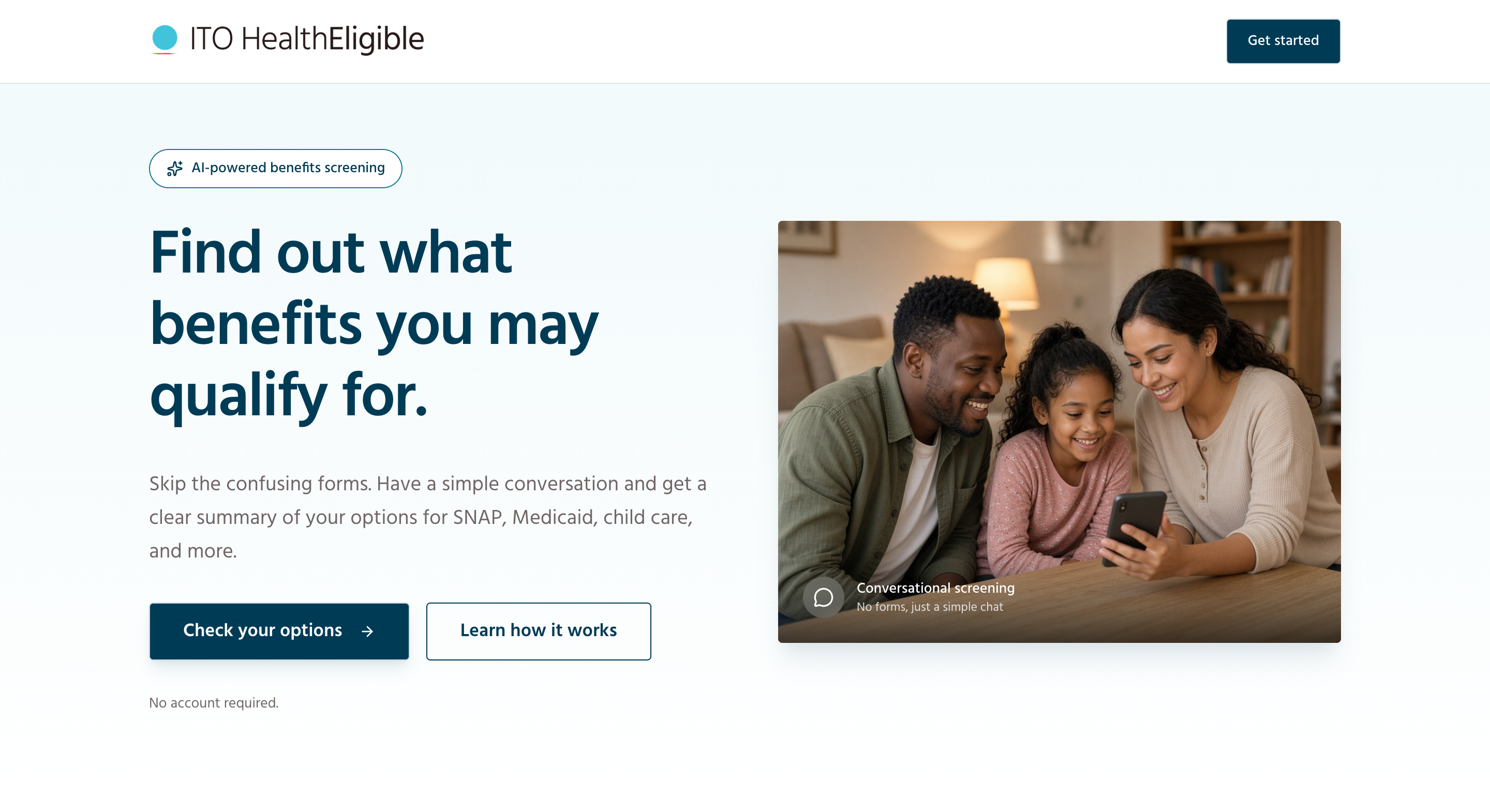
Every feature traces back to a reason people quit. We built on methods proven to raise completion in public benefits, and made accessibility and voice the foundation.
People quit long, repetitive forms
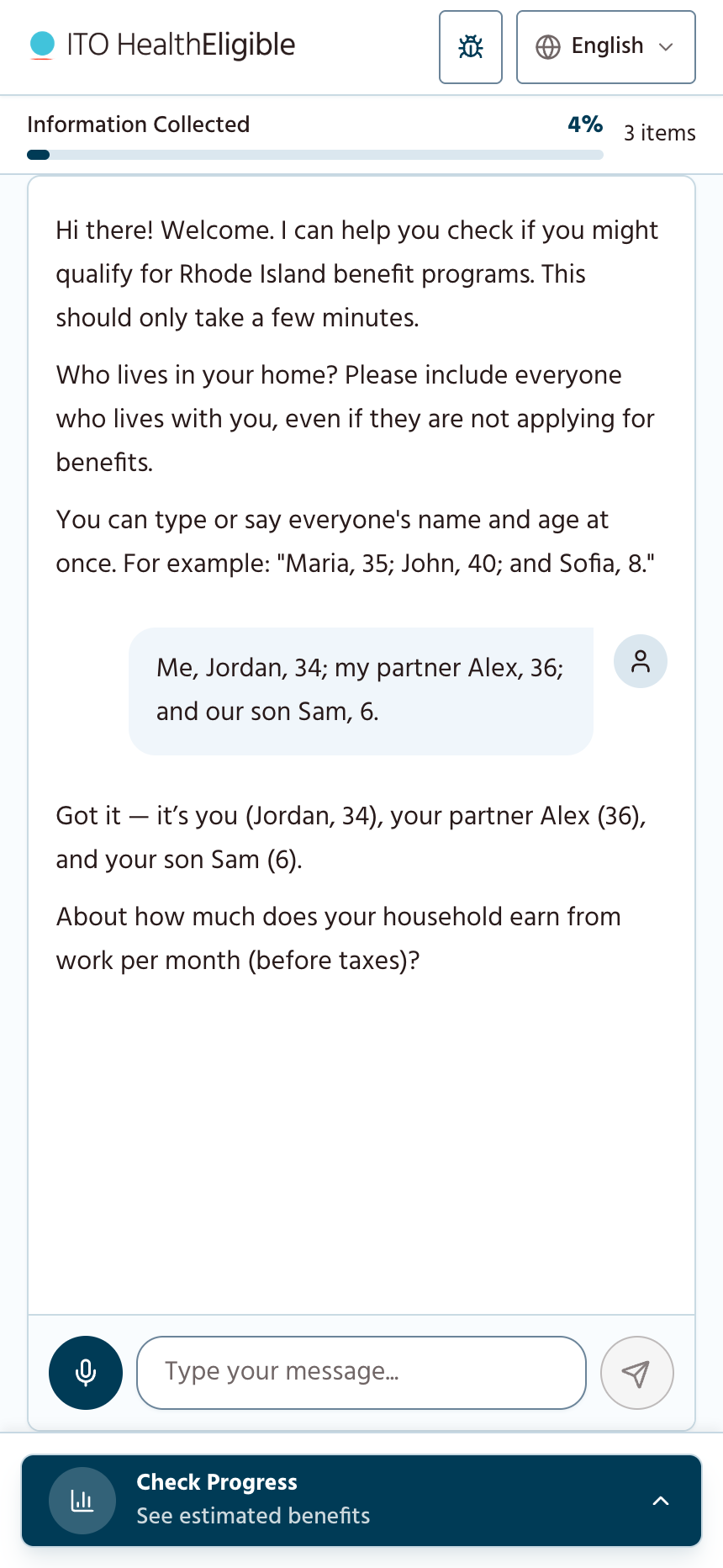
- One conversation screens for all four programs, so no question is asked twice.
- One question at a time, in plain language at about an 8th grade reading level.
People don’t have exact numbers
- Ranges and “I don’t know” are valid answers. No paystubs needed.
People worry about what happens to their information
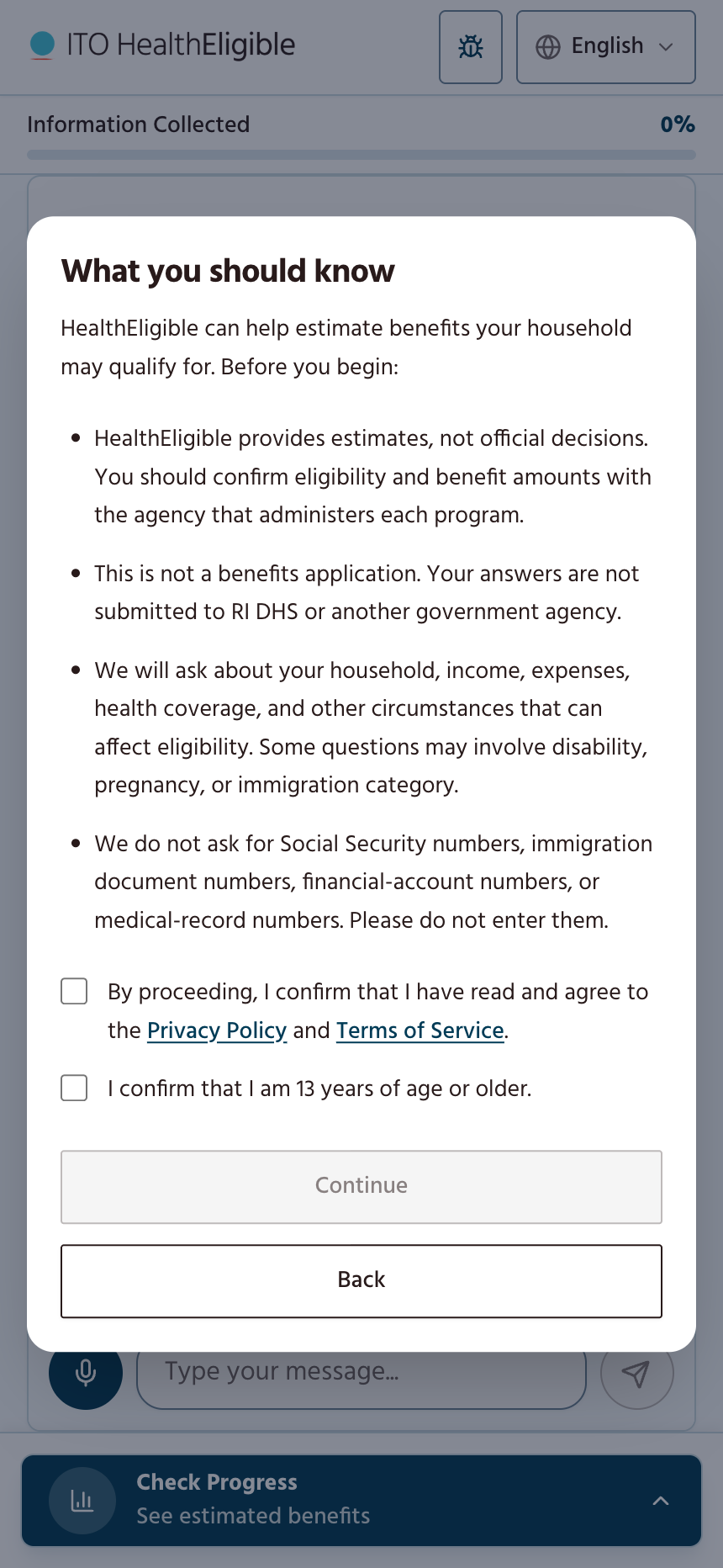
- A short disclosure before the first question: this is an estimate, not an application, and nothing is sent to the state.
- No account or registration.
Many people only have a phone, and some can’t easily read or type
- Mobile first, built to WCAG 2.1 AA from the start, with full keyboard and screen reader support.
- ITO’s design system scaled up for the public: larger type, higher contrast and bigger touch targets.
- Voice as a primary way in. Residents can talk through the screening, and voice fills the same fields as tapping, so every answer can be checked on screen.
People need to know where they stand
- A progress bar shows how much is collected.
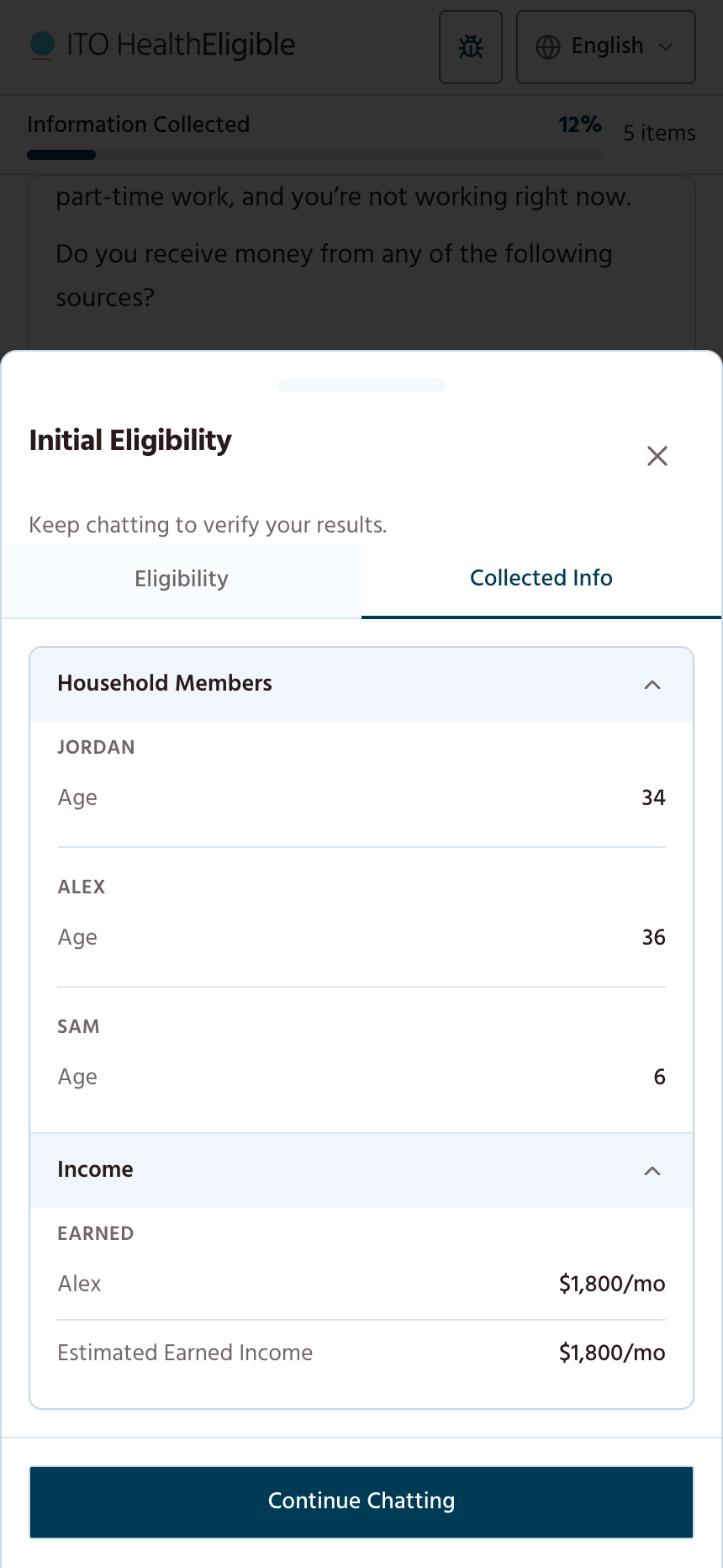
- A drawer shows the answers collected so far and an early eligibility read, so people can correct anything as they go.
People fear losing benefits by earning more
- A benefit cliff check shows when a household is close to an income limit, and what a raise could cost them.
 View fullsize
My role
I led product and design, and stood up the team that built it: an AI engineer and an associate product manager, working with ITO’s engineering team. I owned the product direction, the interview design and its quality bar, and the system design that keeps the product accurate over time.
I set up how the team works: a weekly cadence to review real sessions, policy changes and model choices, and a weekly release. The product moved from an early prototype to a production stack with a CI/CD pipeline.
The product, not just the interface
HealthEligible is designed as a system, not a form with a chat window. Each part exists because of a need.
System overview, seven stages. A resident or navigator comes in by mobile, voice or text and moves through a guided interview, which builds a household snapshot. The snapshot goes to rules-based screening. Policy and rules, built from official regulations and human review, feed an approved rules library into that same screening stage. Screening leads to resident results, and to oversight for the team.
01
Accessible entry
- Residents and navigators
- By mobile, voice or text
02
Guided interview
- Plain-language questions
- One conversation across programs
- Follow-ups when answers are unclear
03
Household snapshot
- Household members
- Income and work
- Housing and care costs
- Other circumstances
04
Policy and rules
- Official regulations
- Rules drafted from policy
- Human review
- Approved rules library
Feeds rules-based screening
05
Rules-based screening
- SNAP
- Medicaid
- RI Works
- CCAP
- Approved program rules
- Benefit cliff check
06
Resident results
- Likely programs
- What needs review
- Documents
- Application links
- Plain-language summary
07
Oversight
- Screening trace for review
- Quality monitoring
- Insight into barriers and drop-off
- Residents need one easy way in, so there is one conversation for all programs, by voice or text.
- Answers need to be accurate and reusable, so the conversation builds a structured household snapshot, not a transcript.
- Eligibility has to be right, so deterministic program calculators decide it from approved rules. The AI gathers and confirms facts. It does not decide eligibility.
- People ask “why,” so the assistant can answer questions about a rule, grounded in the regulation text.
- Results need to lead somewhere, so people get likely programs, what still needs review, documents to gather and where to apply.
- The team needs to see what’s working, so every screening is traced for quality review.
Keeping these parts separate is what makes the product safe and maintainable. The conversation can improve without touching the rules, and the rules can change without rewriting the conversation.
Policy that stays current
Most eligibility screeners hard-code their rules. Every policy change means someone has to notice it and update the code by hand, so screeners drift out of date and give people wrong answers.
HealthEligible watches policy instead of hard-coding it.
Policy loop, five steps that repeat. The product watches official sources. Changes are detected by comparing adopted text with the last version, and by an agent that finds pending, emergency and federal changes and must quote the source. The system suggests updates to the rules, calculators, interview and prompts. The policy lead reviews every change, and nothing applies automatically. Engineering ships the approved change, then monitoring starts again.
01
Official sources
- RI regulation pages
- Rulemaking documents
- Federal notices
02
Changes detected
- Adopted text compared with the last version
- Pending, emergency and federal changes found by an agent that must quote the source
03
Suggested updates
- Drafted edits to rules, calculators, interview and prompts
04
Policy lead review
- Nothing applies automatically
05
Product updated
- Engineering ships the approved change
Back to monitoring
- Official sources. The rules are built from Rhode Island regulation, and the product checks those sources on a schedule.
- Change detection. When adopted regulation text changes, the product compares it with the version the rules were built from.
- Pending changes. An AI agent reads each regulation’s page the way a person would, and reports proposed rules, adopted rules with future dates, emergency rules and federal notices. It keeps a finding only when it can quote the official document.
- Suggested updates. For each change, the system drafts the specific edits to the rules, calculators, interview and prompts.
- Human approval. Suggestions are never applied automatically. The policy lead reviews every change before engineering ships it.
The October 2026 SNAP update showed why this matters. A federal change took effect before it appeared in the state regulation. Checking only adopted state rules would have missed it.
This is the long-term value of the product. Keeping a screener accurate becomes a review task, not a rebuild.
Designing the conversation around real behavior
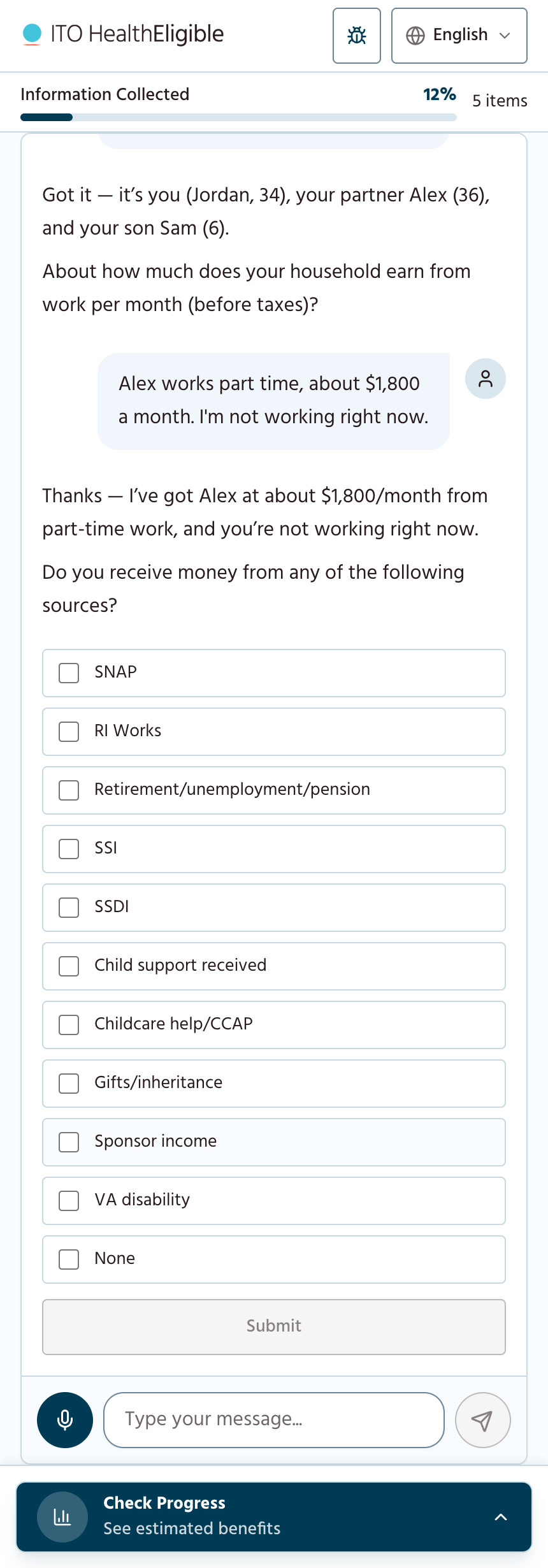
The first week of sessions showed people reporting benefits like SSI or unemployment when asked about work income, then having to repeat themselves.
We restructured income into phases:
- First, who in the household works. Then one person’s income at a time, confirmed back to them.
- Next, who receives other income, and from which sources.
- Details people volunteer are captured without asking again.
- “Nobody” completes a step. Silence or an unclear answer gets a follow-up.
Testing also showed that sensitive questions need context. When a question depends on an earlier answer, the assistant says which answer and why it’s asking.
Built to last
- Accuracy. The calculators were checked against real cases supplied by RI DHS, with benefit estimates within 10%.
- Privacy. Residents share income, household and disability information. Every AI provider has to sign a HIPAA agreement, keep no data and process in the US.
- Quality. Every session is traced in a HIPAA-compliant tool so the team can review conversations without exposing personal data.
- Cost. Model choice weighs conversation quality against cost per session. Testing showed an open model could run the same conversation at about half the cost.
Launch and measurement
HealthEligible launched in beta in August 2026 and is live at healtheligible.org.
The people who most need benefits aren’t searching for a screener. The launch put QR codes on bus shelters across Providence, opening straight into the mobile, voice-first experience.
We’re measuring:
- How far people get, compared with the 34% on the state form
- Completion rate
- Results by program
- Voice versus typing
- Where people drop off